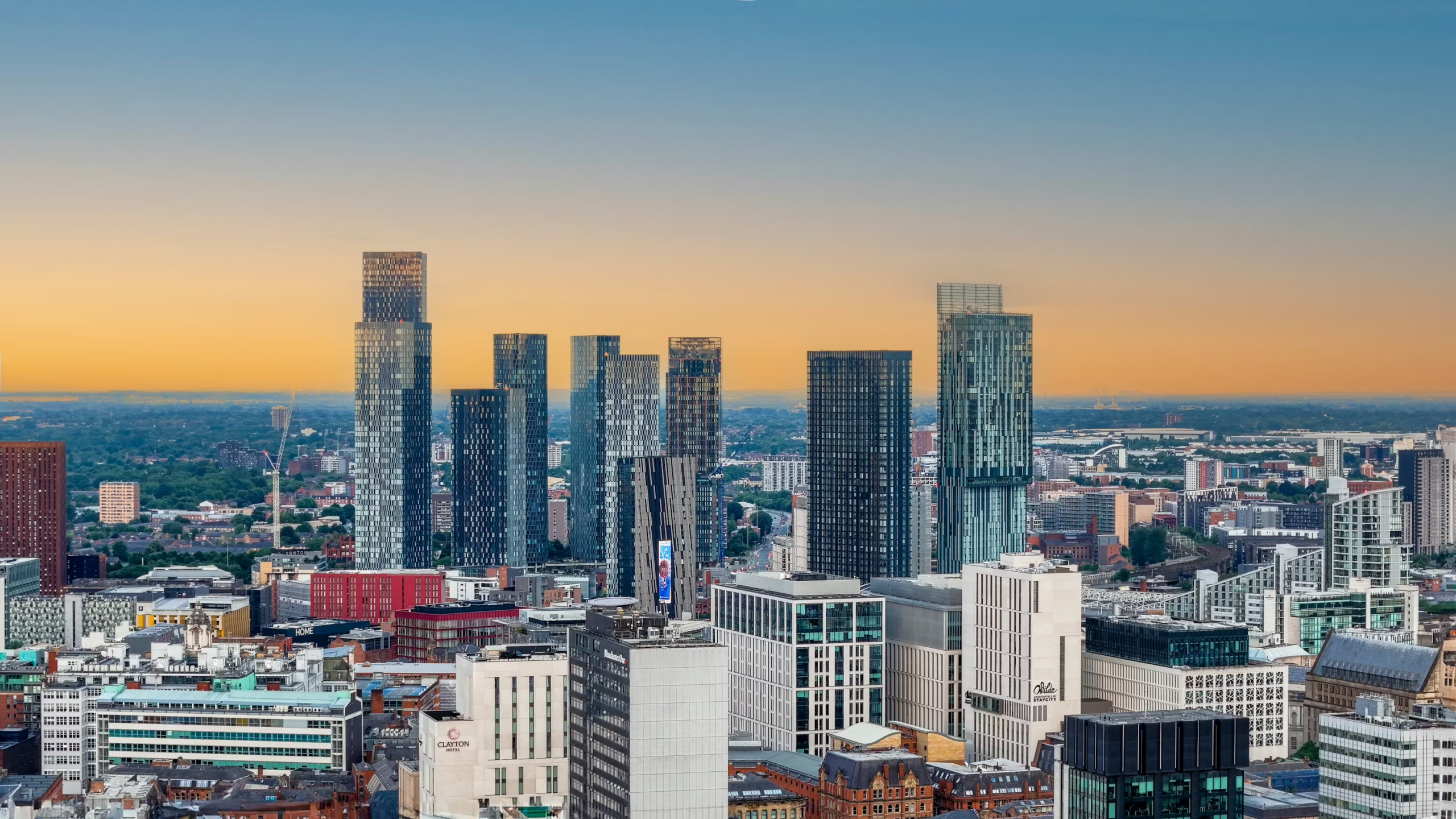
Manchester has a long history of technological innovation, from its claim-to-fame as the world’s first industrialised city, where factories churned out fabric at previously unimaginable speeds, to its rollcall of world-famous scientists and inventors. It was Manchester where John Dalton produced his visionary atomic theory, while a post-war Alan Turing, fresh out of Bletchley Park, worked at Manchester University to help develop modern computers.
Nowadays, following a tough few decades for the city’s economy, Manchester has reprised its role as one of the UK’s leading tech destinations. As of 2026, the city is home to roughly 10,000 digital and tech businesses, and a central population set to more than double over the next ten years. What’s more, this month, the launch event for UK Tech Week – one of the country’s biggest annual tech events – is being hosted in the heart of Manchester, highlighting the city’s position as a major centre for technology and innovation.
All of which begs the question: is Manchester on route to becoming the UK’s new tech capital?
A start-up haven
One of the reasons why Manchester enjoys such a buzzing tech community is the recent influx of innovative start-ups to the city. In 2025, there were more than 1,600 tech start-ups and scaleups in Greater Manchester, drawn in by the prospect of a strong business ecosystem and significant government funding opportunities.
With its three central universities, the city also offers start-ups a highly educated workforce. In particular, the University of Manchester regularly ranks within the UK’s top fifteen higher education institutes for both engineering and computer science. Moreover, skilled workers from the rest of the UK and beyond are attracted to Manchester by its vibrant nightlife, connectivity, and affordable cost of living, compared to London.
Generous regional funding is also a major attraction for businesses thinking about locating or relocating to Manchester. Last Autumn, Manchester was awarded a funding package of £20 million pounds to support tech and science businesses and research projects – the latest of several grants received from the Local Innovation Partnerships Fund over the past few years.
Importantly, the more tech companies that chose to locate in Manchester, the more opportunity there is for other enterprises and professionals. Manchester is currently the fastest growing region for AI companies (the number of AI company registrations rose by 184% between 2020 and 2025, compared to 74% in London) and one of the top UK cities for start-ups. Talent breeds talent – and a strong community of young, innovative businesses has helped transform Manchester from a relic of its former glory to a city of the future.
What about London?
Of course, we mustn’t lose sight of the ongoing predominance of the UK’s “big-three” cities for tech development. London has the incommensurable advantage of being the UK’s political and financial capital, while Cambridge and Oxford boast world-class research institutes which sprout from their ancient universities (it was just over a year ago that the Chancellor Rachel Reeves announced plans to create Britain’s very own ‘Silicon Valley’ between those two academic towns). All three of these cities have a long and formidable history at the heart of British innovation that isn’t easy to match.
What’s clear though, is that the gap is closing between Manchester and these more traditional tech hubs. Indeed, as of late 2025, Manchester’s economy was increasing at 3.1% per annum – making it the fastest-growing city in the UK. And while Cambridge and Oxford are ultimately restricted by their small size and high ground rents, Manchester has oodles of affordable space to accommodate new enterprises and professionals.
And so, whether or not it outpaces London as the tech capital of Britain, one thing seems guaranteed: Manchester’s tech economy is set for a very bright future.